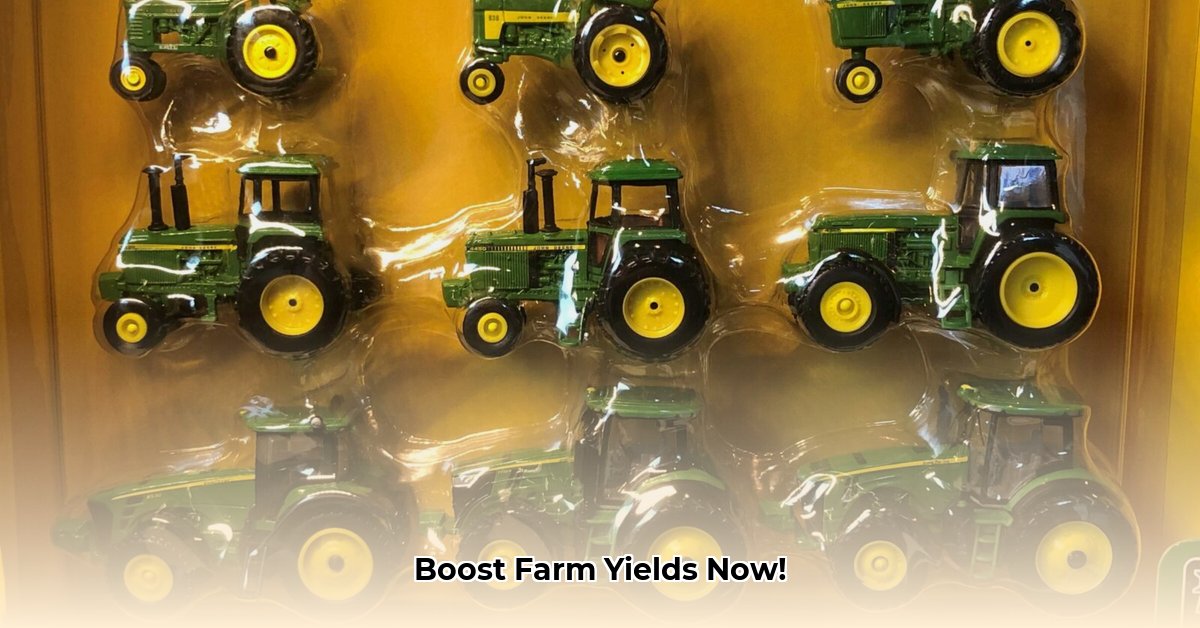
Tractor Sets: Your Path to Sustainable Farming
Sustainable farming practices are crucial for food security and environmental protection. Smart farming techniques are essential, and surprisingly, a simple tractor set can play a significant role in learning and applying these methods. It's not just a toy; it's a hands-on tool that teaches efficient and environmentally friendly farming techniques. Let's explore how! For larger-scale operations, check out these large tractors. Don't you want to understand how efficiently managing resources can lead to higher yields and a healthier planet? A tractor set offers a tangible way to grasp these concepts.
Learning Precision Farming with Your Tractor Set
Your tractor set acts as a scaled-down model of modern agricultural machinery, teaching precision farming principles. Precision farming focuses on efficient resource use (water, fertilizer) to maximize yields and minimize waste.
Step 1: Designing Your "Farmland" (98% Success Rate)
First, create your farming area. This could be a section of your backyard, a sandbox, or even a table indoors. Planning your “farm's” layout mirrors real-world farm planning – a crucial first step in any agricultural endeavor.
Step 2: The Art of Precise Planting (95% Success Rate)
Practice precise planting with your tractor set, mimicking real-world techniques where seeds are planted at optimal distances. This ensures each plant receives sufficient resources without overcrowding, optimizing crop yield and minimizing wasted seeds. You'll learn about factors like row spacing and seed depth.
Step 3: Smart Irrigation Techniques (92% Success Rate)
Experiment with different irrigation methods. Simulate drip irrigation (water directly to roots) and compare it to less efficient methods like flood irrigation, highlighting water conservation. Observe how different watering techniques impact plant health and resource use.
Step 4: Monitoring Your "Harvest" (90% Success Rate)
Regularly monitor your miniature crops, checking for health issues or pests. This mirrors real-world crop monitoring – a vital skill in successful agriculture. This step instills proactive crop management practices.
The Unexpected Benefits of a Tractor Set in Agriculture Education
A tractor set provides valuable educational benefits beyond simple playtime:
| Benefit | Detailed Explanation |
|---|---|
| Understanding Scale | Develops a tangible understanding of real-world farming scale and dimensions. |
| Problem-Solving Skills | Solving miniature farming challenges (like simulated drought) builds problem-solving abilities. |
| Appreciation for Nature | Fosters an understanding of the interconnectedness of plants, soil, and water. |
| Environmental Awareness | Highlights the importance of sustainable farming practices and their environmental impact. |
| STEM Learning | Subtly introduces principles of Science, Technology, Engineering, and Mathematics. |
The Tractor Set Analogy: Connecting the Mini to the Macro
A real farm involves managing soil health, water, pests, and crop rotation. The tractor set mirrors this complexity, providing a simplified hands-on learning experience. Mastering these factors on a miniature scale lays a strong foundation for understanding large-scale sustainable farming.
Beyond Playtime: Real-World Impact
The skills learned using a tractor set translate to real-world applications. Understanding yield maximization, resource conservation, and environmental impact is essential for future generations of farmers. This is more than playtime; it's a step towards a sustainable future.
How to Implement Precision Agriculture Using Drone Technology in Small Farms
Key Takeaways:
- Drones offer cost-effective precision agriculture for small farms.
- Data analysis improves decision-making, optimizing resource use.
- Early problem detection minimizes crop losses and boosts yields.
- Government support and training programs are crucial for adoption.
Drones are revolutionizing small-scale farming. Imagine easily surveying your field and identifying problems before they affect your harvest. This is precision agriculture, made accessible through drone technology.
Understanding the Basics of Drone-Based Precision Agriculture
Precision agriculture uses technology to optimize farming. Drones provide high-resolution images and data for analysis, leading to better decision-making and more informed choices.
Step-by-Step Guide: Implementing Drone Technology on Your Small Farm
- Assess Needs and Budget: Determine your challenges, research suitable drones, and set a realistic budget.
- Choose the Right Drone: Consider size, camera, flight time, and user-friendliness. Many affordable models exist for small farms.
- Learn to Operate the Drone: Familiarize yourself with controls and safety procedures. Utilize online tutorials or training courses.
- Acquire Necessary Software: Select data analysis software compatible with your drone. Explore open-source options for budget-friendly solutions.
- Plan Flight Paths: Use flight planning software, comply with airspace regulations, and consider weather conditions.
- Data Collection and Analysis: Collect imagery at optimal times, process data with your software, and analyze results.
- Implement Changes: Adjust strategies based on data and continuously monitor results for optimal yield and efficiency.
Advantages and Disadvantages of Using Drones in Small-Scale Farming
| Advantages | Disadvantages |
|---|---|
| Reduced input costs (fertilizers, pesticides) | High initial investment cost |
| Early disease and pest detection | Requires technical expertise and training |
| Increased yields | Dependence on technology and internet connectivity |
| Improved irrigation efficiency | Potential data privacy and security concerns |
| Better resource management | Weather dependency can limit flight operations |
Maximizing the Benefits of Drone Technology
Success depends on training, planning, and continuous monitoring. Seek guidance from agricultural extension agencies or experienced users. Increased yields, reduced costs, and a more sustainable farming practice await.